NORDIC Ratgeber

NORDIC Knowledge Hub · Insight for care

Safe care in the bathroom, at the toilet and at the bedside.

In-depth guides, current market developments and decision aids – for equipment suppliers, care homes, hospitals and community equipment services. Built on official data and procurement practice. Written with more than 30 years of design and manufacturing experience.

Read the main guideMarket radar
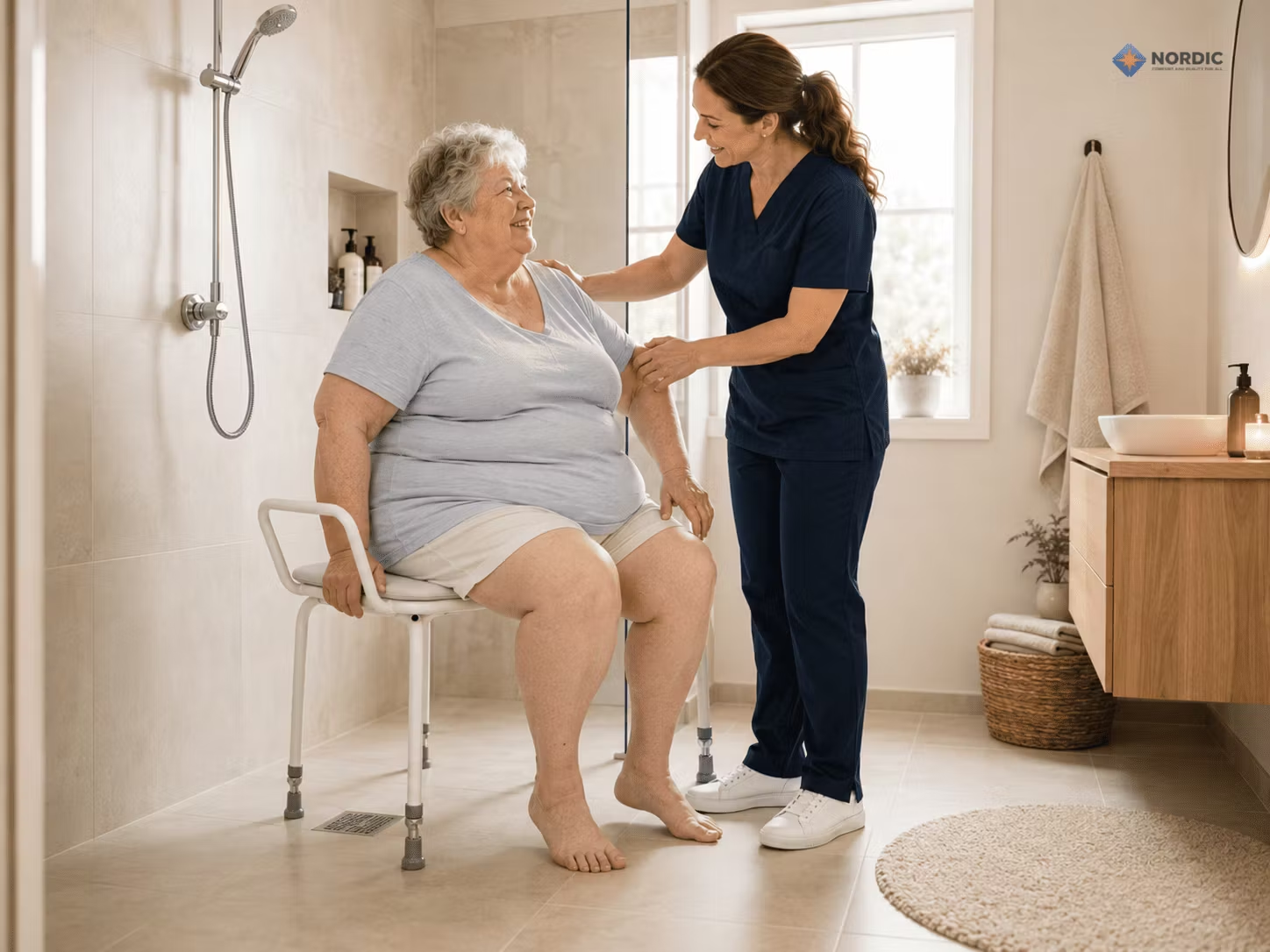
Carer supporting a resident on a NORDIC shower stool
Since 1993100% own European productionCE marked5-year warrantySources in every articleReviewed by care & OT professionals
The situation in numbers

Demand for care is rising – and getting heavier.

The number of people aged 85 and over in the UK is projected to double from 1.75 million in 2024 to 3.6 million by 2049. [1] Most older people live at home: in England and Wales, 2.5% of over-65s lived in a care home at the 2021 Census. [2]

At the same time, 30% of adults in England live with obesity [10], and around a third of over-65s fall at least once a year. [11] For councils, care providers and equipment suppliers this means more equipment at home, more bariatric requirements – and a bathroom that sits at the centre of falls prevention.

People aged 85+ in the UK
* ONS 2024-based projection [1]
1.75m20243.6m2049*
≈ 210,000
fall-related emergency admissions of people 65+ in England, 2022/23 [11]
£4.4bn
annual UK cost of fragility fractures [11]
£723m
Disabled Facilities Grant funding in England, 2026/27 [7]
30%
of adults in England live with obesity (2024) [10]
In use

Where the right equipment eases everyday care

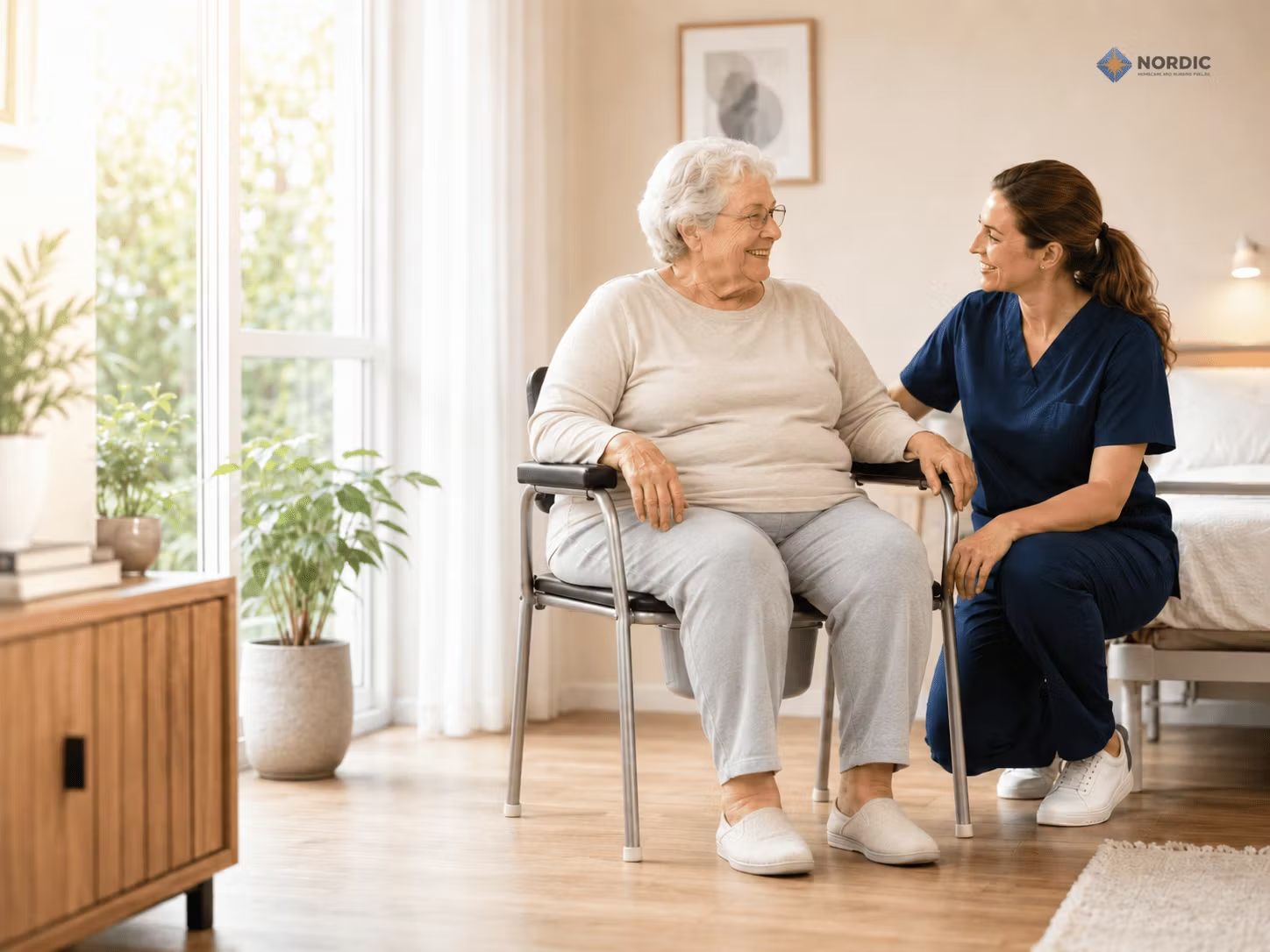
Carer with an older woman on a NORDIC commode chair
Toileting and transfers – standing up steadily, with dignity.
Older woman in a care bed with a NORDIC overbed table
At the bedside – eating, reading and working with the right table.

Three perspectives

What funders, suppliers and care providers are dealing with

Bathing and toileting equipment in the UK is judged from three sides: those who fund it, those who supply it – and those who use it to deliver care.

Funders
NHS and local authorities
Equipment is free at the point of use, so buyers focus on whole-life cost, durability and how quickly a product can be issued, collected and reissued.
Figures & sources (4)
  • Councils must not charge for community equipment and minor adaptations costing £1,000 or less. [4]
  • Disabled Facilities Grant: up to £30,000 per applicant in England, means-tested. [5]
  • DFG funding: £711m in 2025/26 within the Better Care Fund [6], £723m in 2026/27, helping around 60,000 people a year. [7]
  • Zero-rate VAT applies to commode chairs and toilet-rising aids supplied for a disabled person's personal use. [8]
Buyers · suppliers
Community equipment services and dealers
Clear product data, CE documentation and reliable stock decide whether a supplier stays on a framework.
Figures & sources (3)
  • Integrated community equipment services are jointly commissioned by the NHS and councils; ADASS calls them core system infrastructure. [9]
  • The UK will accept CE-marked medical devices on a long-term basis. [12]
  • VAT relief depends on the end user: group use in hospitals or nursing homes is not covered. [8]
Buyers · providers
Care homes and hospitals
Every fall prevented in the bathroom saves hospital time and protects independence. Equipment must be safe for heavier residents and easy for staff to use.
Figures & sources (4)
  • 278,946 people aged 65+ lived in care homes in England and Wales in 2021; 56.4% of them were 85+. [2]
  • Care home bed occupancy in England: 86.1% (December 2025). [3]
  • Over 70,000 hip fractures a year in England, Wales and Northern Ireland – a number that could double by 2060. [12]
  • Around half of people over 80 fall at least once a year. [11]
Requirement → response

Where the market meets NORDIC

We link each requirement from funders, procurement and care to what NORDIC actually brings – with no promises we don't control ourselves.

What the market asks for
What NORDIC brings
Access to the UK market for EU-made devices. [12]
CE marked, 100% own European production since 1993. Long-term CE recognition means no separate UKCA route for our range.
Free-at-point-of-use equipment must last and be reissued. [4]
5-year warranty, spare parts available separately. Replace wear parts instead of whole products – extending service life.
30% adult obesity and rising bariatric need. [10]
XXL range up to 300 kg. Shower stool, shower bench and commode as one matched line: HEAVY, BERTA, COMFORT.
Falls are the biggest risk in the bathroom and at the toilet. [11]
Complete range for bath, toilet and bedside. One supplier for the high-risk moments: showering, toileting, getting up.
Frameworks require clear product data. [9]
Full technical documentation. Dimensions, load ratings and instructions ready for specifications.
Reliable supply for dealers.
European central warehouse. Pallet terms, product training and sales support through the partner programme.

Market radar

What is changing in equipment and care right now

Monthly context on funding, regulation and standards. Short, sourced – and with what it means for your purchasing and advice.

NORDIC Duschbank XXL HEAVY
In short

In bariatric care, the weight rating alone does not decide. Seat width, footprint, slip resistance, height adjustment and space for the carer must fit together – and be checked systematically before purchase.

Main guide · XXL & bariatric care

Bariatric care in the bathroom: a guide for procurement and care managers

Almost one in three adults in England lives with obesity. [10] In care homes and at home, caring for heavier people is becoming everyday practice rather than the exception – and the bathroom is the most critical room. This guide sets out what a product rated up to 300 kg really has to deliver, and how to match need, space and equipment.


[Name], Product Management NORDIC · reviewed by [Name], [Registered Nurse / Occupational Therapist]
updated [date]
Checklist: choosing bathroom equipment for heavier users
  1. 1Load rating with headroom: it must exceed body weight – sitting down adds extra force.
  2. 2Measure seat width and depth: on the person, not by eye. Seats that are too narrow raise pressure and fall risk.
  3. 3Check the footprint: wide leg stance against tipping sideways, non-slip feet on wet floors.
  4. 4Set the seat height: feet flat on the floor, knees at roughly a right angle.
  5. 5Plan the transfer: from which side? Are armrests needed – fixed or removable?
  6. 6Space for the carer: measure working space, shower area and door width before ordering.
  7. 7Hygiene: hygiene cut-out where needed, smooth surfaces, cleaning as per the instructions.
  8. 8Documentation and service: confirm CE marking, instructions, spare parts and warranty up front.
Topics

Answers by care situation

Four care situations where the right equipment makes the difference – with the matching NORDIC product lines.

XXL & bariatric
XXL
XXL & bariatric

Load capacity, seat width and stability for people up to 300 kg.

HEAVY · BERTA · COMFORT
Bathroom safety
Bathroom safety

Showering, bathing, getting in and out: reduce fall risks systematically.

MODULAR · LINA · WALL · SAFETY · SWIVEL
Toileting aids
Toileting aids

Sitting down, standing up, independence: the right support for each situation.

ECONOMY · STAND UP · SIMPLY
Bedside & standing
Bedside & standing

Sitting up, transferring, care in bed – easing the load for everyone.

TOM · ASSISTENT · EASY · Overbed tables
Recommended reading

Reports, guidelines and data to read further

Selected primary sources from statistics offices, regulators, professional bodies and research – linked directly.

NICE
New guideline on falls, NG249 (Apr 2025)

NICE guidance on preventing falls and what falls cost the NHS.

View source ↗
ONS
National population projections, 2024-based (28 Apr 2026)

ONS projections: how fast the over-85 population will grow.

View source ↗
ADASS
Community equipment services as core infrastructure (5 Jun 2026)

Why community equipment services should be treated as core infrastructure.

View source ↗
HMRC
VAT Notice 701/7 – reliefs for disabled and older people

Which aids qualify for VAT relief – and which do not.

View source ↗
GOV.UK
Disabled Facilities Grants

How the Disabled Facilities Grant works and who is eligible.

View source ↗
MHRA / GOV.UK
Indefinite recognition of CE-marked medical devices (21 Oct 2026)

The UK decision to recognise CE-marked medical devices long term.

View source ↗
Our standard

Guides that buyers actually use.

We don't write about products we buy in. Since 1993 we have designed and manufactured our own equipment in Europe. Every article combines that experience with verifiable sources and practitioners' views – and is reviewed by a care or therapy professional before publication.

For dealers & care providers
NORDIC Partner Programme

Trade terms, product training and sales materials – including the checklists from the knowledge hub.

Contact for dealers and care providers: [email] · [phone]
Sources · Show all sources (14)

  1. ONS: National population projections, 2024-based (28 Apr 2026)
  2. ONS: Older people living in care homes in 2021
  3. DHSC: Adult social care provider statistics, December 2025
  4. Care and Support (Charging and Assessment of Resources) Regulations 2014, reg. 3
  5. GOV.UK: Disabled Facilities Grants
  6. GOV.UK: Better Care Fund policy framework 2025 to 2026
  7. GOV.UK: Cash boost for disabled adults – DFG 2026/27 (17 Feb 2026)
  8. HMRC: VAT Notice 701/7 – reliefs for disabled and older people
  9. ADASS: Community equipment services as core infrastructure (5 Jun 2026)
  10. NHS England: Health Survey for England 2024 – overweight and obesity
  11. NICE: New guideline on falls, NG249 (Apr 2025)
  12. BOA: National Hip Fracture Database report 2025
  13. MHRA / GOV.UK: Indefinite recognition of CE-marked medical devices (21 Oct 2026)
  14. DHSC Social Care blog: Commitment to adult social care (6 Aug 2026)

This content is for guidance only and does not replace an individual assessment by a dealer, nurse, occupational therapist or doctor.

Nicht gefunden, was Sie suchen?

Dann entwickeln wir es gemeinsam.

Als Hersteller mit eigener europäischer Fertigung entwickeln wir auf Anfrage neue Hilfsmittel und gestalten sie gemeinsam mit Ihnen – bis hin zur eigenen Marke. Erzählen Sie uns, was Ihnen fehlt: Wir freuen uns auf Ihre Rückmeldung und ein Gespräch.

Projekt anfragen →

Skandinavische Pflege- und Reha-Hilfsmittel aus eigener europäischer Fertigung – für Sanitätshäuser, Kliniken und Pflegeeinrichtungen.

NORDIC Partner werden →

Sortiment

Service

Kontakt

+49 40 600 385 3090

Mo–Fr · B2B-Fachberatung

Nordic Activity AB · Lokegatan 5, 263 37 Höganäs, Schweden

© 2026 NORDIC · Nordic Activity AB · Pflegehilfsmittel seit 1993 AGBDatenschutzImpressum